
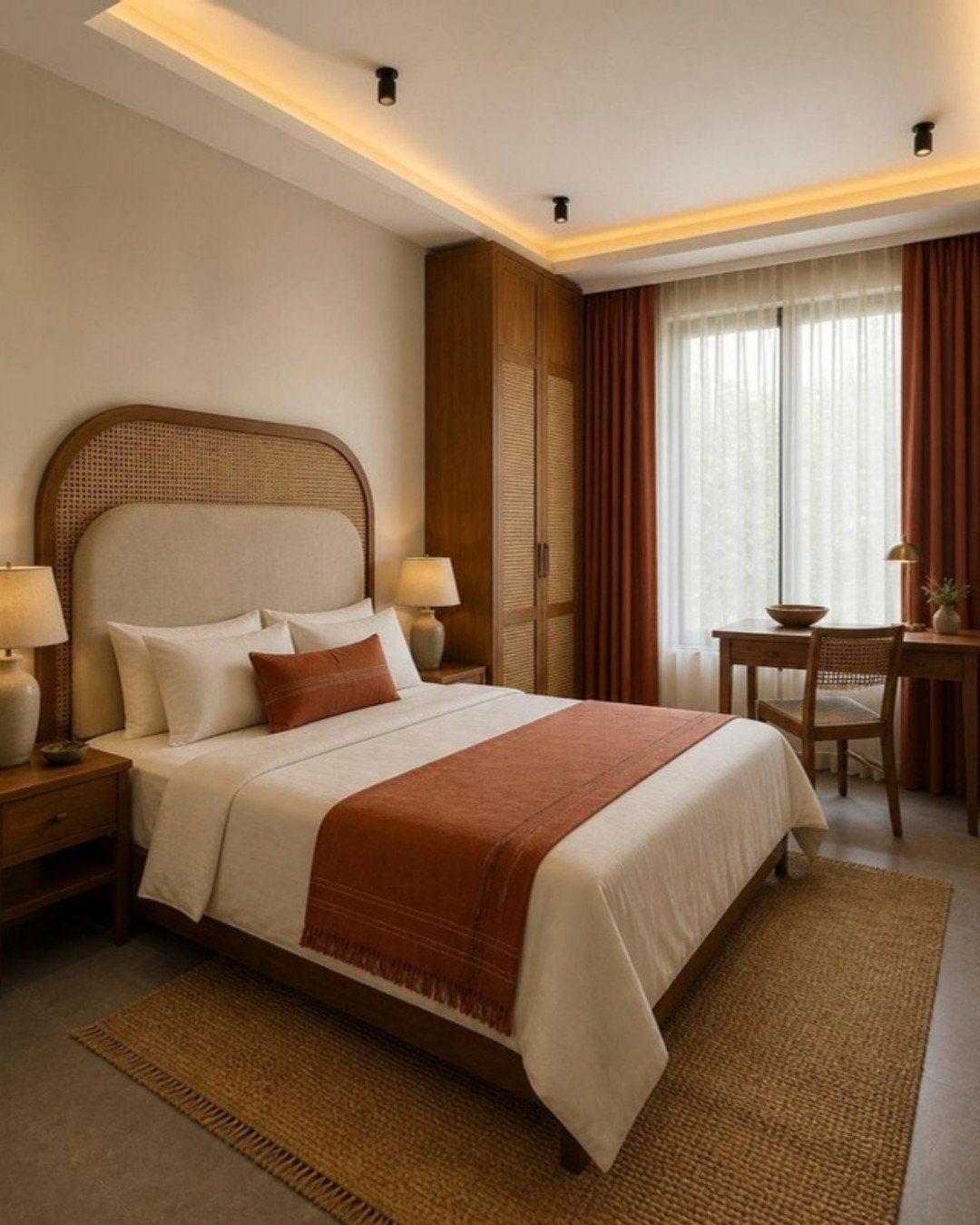
Many families in Bengaluru would like their bedrooms to follow vastu, and then discover that an apartment gives them very little room to manoeuvre. The walls, windows, attached bathroom and wardrobe niche are fixed by the builder, and the bed often fits in only one or two positions. This guide sets out the commonly followed vastu preferences for bedrooms and, more usefully, what you can do when the layout does not cooperate.
A clear note before we begin: vastu shastra is a traditional system of beliefs about orientation and placement. The points below are presented as traditional preferences that many households value, not as scientific facts or guarantees of any outcome. Practitioners also differ among themselves, so if vastu is important to your family, consult a practitioner you trust. Our role as designers is to respect those preferences while keeping the room comfortable, safe and practical.
First, find your directions properly
Much confusion comes from guessing which way a room faces. Stand in the centre of the bedroom with a compass or a phone compass app, away from metal furniture and appliances, and note where north lies. Mark the four directions on a printed floor plan. Many apartments are built at an angle to the cardinal directions, in which case walls face north-east or south-west rather than due north or south; practitioners generally work with the nearest direction.
Which bedroom for whom
Traditional vastu preferences commonly cited for the allocation of rooms are:
- Master bedroom: the south-west part of the home is traditionally preferred for the head of the household.
- Children’s and guest bedrooms: the west, north-west or east are often suggested.
- North-east: traditionally kept for prayer, study or open space rather than a master bedroom.
In an apartment the builder has usually decided which room is the master, with the larger wardrobe niche and bathroom. If that room is not in the south-west, families who follow vastu sometimes simply use the south-west room as the parents’ room regardless of what the brochure calls it. If neither option is practical, the focus shifts to the placement of the bed within the room you have.
Bed direction
The direction in which the head points while sleeping is the vastu point most households care about.
- Head towards the south is the most widely cited traditional preference.
- Head towards the east is also considered favourable, and is often suggested for students.
- Head towards the west is treated as acceptable by many practitioners.
- Head towards the north is traditionally avoided.
Other commonly mentioned preferences are that the bed should have a solid wall behind the headboard rather than a window, that it should not sit directly under an exposed beam, and that it should be placed towards the south-west portion of the room with some space on both sides.
Where practical design agrees
Several of these preferences coincide with ordinary good planning. A headboard against a solid wall is quieter and less draughty than one under a window. Space on both sides of a double bed means neither person has to climb over the other, and allows two bedside tables and two reading lights. A bed that does not face the door directly gives more privacy. So it is often possible to satisfy both vastu and comfort with the same layout.
Mirrors and dressing tables
The traditional preference is that a mirror should not reflect the bed, and in particular should not face a person lying down. Mirrors on the north or east walls are commonly suggested.
In compact bedrooms the only spare wall is often the one opposite the bed, and mirrored wardrobe shutters are popular because they make a room feel larger. Ways to reconcile this:
- Put the full-length mirror inside a wardrobe shutter, so it is visible only when the door is open.
- Place the dressing unit in the passage to the bathroom or in the wardrobe niche, out of the bed’s line of sight.
- Use a dresser with a sliding or folding panel that covers the mirror when not in use.
- Choose tinted glass, fluted glass or lacquered glass shutters instead of clear mirror if you want reflectivity without a true reflection.
- Where a mirror already exists opposite the bed, some families simply draw a curtain or blind across it at night.
Wardrobe placement
Traditionally, heavy storage is preferred along the south or west walls of the bedroom, with the north and east kept lighter and more open. A locker or safe is commonly placed so that it opens towards the north.
In practice, apartment bedrooms come with a wardrobe niche, and building the wardrobe anywhere else wastes floor space. If your niche is on the north or east wall, consider these approaches:
- Use the niche as designed, and keep the wardrobe visually light with pale finishes and handle-less shutters.
- Place additional heavy storage, such as a chest of drawers or a loft, on the south or west wall to balance it.
- Position the internal locker within the wardrobe so that its door faces the traditionally preferred direction.
Whichever wall it is on, the wardrobe has to work well. Our guides to wardrobe storage planning and sliding versus hinged wardrobes cover internal layouts and door types.
Other commonly followed preferences
- Bedroom door: preferred in the north, east or west walls, opening fully without obstruction. A door that sticks or squeaks is worth fixing in any case.
- Attached bathroom: the traditional preference is to keep the bathroom door closed and to avoid the bed sharing its headboard wall with the WC. From a practical angle, that wall is also where plumbing noise carries.
- Colours: soft, light and earthy tones are generally recommended; very dark or intense colours across the whole room are discouraged. This also matches what most people find restful.
- Electronics: a television, if any, is commonly suggested for the south-east part of the room, and many practitioners advise keeping screens to a minimum in bedrooms. Sleep specialists tend to say the same for different reasons.
- Clutter: storage under the bed is traditionally discouraged, or limited to bedding and clothes. Many households in apartments do need that storage; keeping it tidy and limited to soft items is the usual compromise.
- Pooja space: traditionally not placed in a bedroom. If the bedroom is the only possible place, a small closed unit in the north-east corner is the usual suggestion. Our pooja room design guide has compact options.
Practical workarounds when the layout is fixed
The following are design adjustments, not vastu remedies. They aim to get as close to the traditional preference as the room allows without compromising everyday use.
When the bed can only face one way
- List every possible bed position on the floor plan and note the head direction for each. There is often a second option that people overlook, such as turning the bed through ninety degrees and using a narrower bedside table.
- If the only workable position has the head to the north, some families choose to sleep with their heads at the other end of the bed and fit a low footboard or bench instead of a tall headboard. Others accept the position. This is a personal decision.
- A slightly smaller bed, for example a queen instead of a king, can open up a position that was not possible before.
When the headboard wall has a window
- Fit a tall, solid upholstered or panelled headboard that covers the lower part of the window, with heavy curtains or blinds above.
- Keep the window operable for ventilation and emergency access; do not seal it permanently.
When a beam runs over the bed
- A false ceiling can conceal the beam within a level surface, provided the room has enough height. Our false ceiling guide explains the height you lose and the options.
- Alternatively, shift the bed so that the beam runs over the bedside tables rather than over the sleeper.
When the bed faces the door or the bathroom
- A short partition, a fluted glass screen or a wardrobe return near the entrance breaks the direct line of sight.
- Keep the bathroom door closed and fit a good door closer and exhaust fan.
Do not trade away safety or comfort
We would gently advise against changes that create real problems in pursuit of an ideal layout: blocking a window that is needed for light and air, placing a bed where the wardrobe doors cannot open, squeezing the passage to the bathroom, or shifting electrical points and air-conditioner positions in ways that compromise their function. Structural walls, beams and columns must never be altered. A bedroom that is well ventilated, uncluttered, quiet and easy to move around in serves the spirit of most vastu guidance.
If you are planning a new home, raise your vastu preferences at the very first design meeting. It is far easier to plan the bed wall, switch positions and wardrobe internals around them from the start than to change things after carpentry begins. The same applies to the kitchen, which we cover separately in kitchen vastu for apartments.
Frequently asked questions
The most commonly cited traditional preference is head towards the south, with east also considered favourable and west acceptable to many practitioners. Head towards the north is traditionally avoided. These are traditional beliefs, and practitioners vary.
Traditional guidance prefers that a mirror does not reflect the bed. If you want a full-length mirror in a small bedroom, fixing it inside a wardrobe shutter or in the dressing passage is a simple solution.
Usually not. Moving it wastes space and can make the room awkward. Most families use the niche, keep the finish light and place any additional heavy storage on the south or west side.
Traditional preference is for the south-west, but many apartments do not allow it. Families generally either allocate the south-west room to the parents or concentrate on bed direction within the available room.
Does following vastu increase interior cost?
Not necessarily. Most preferences concern placement, which costs nothing if decided at the design stage. Costs arise mainly when completed work has to be changed, which is why it helps to state your preferences early.
Planning your interiors? Book a free design consultation or WhatsApp us on +91 88845 55998.