
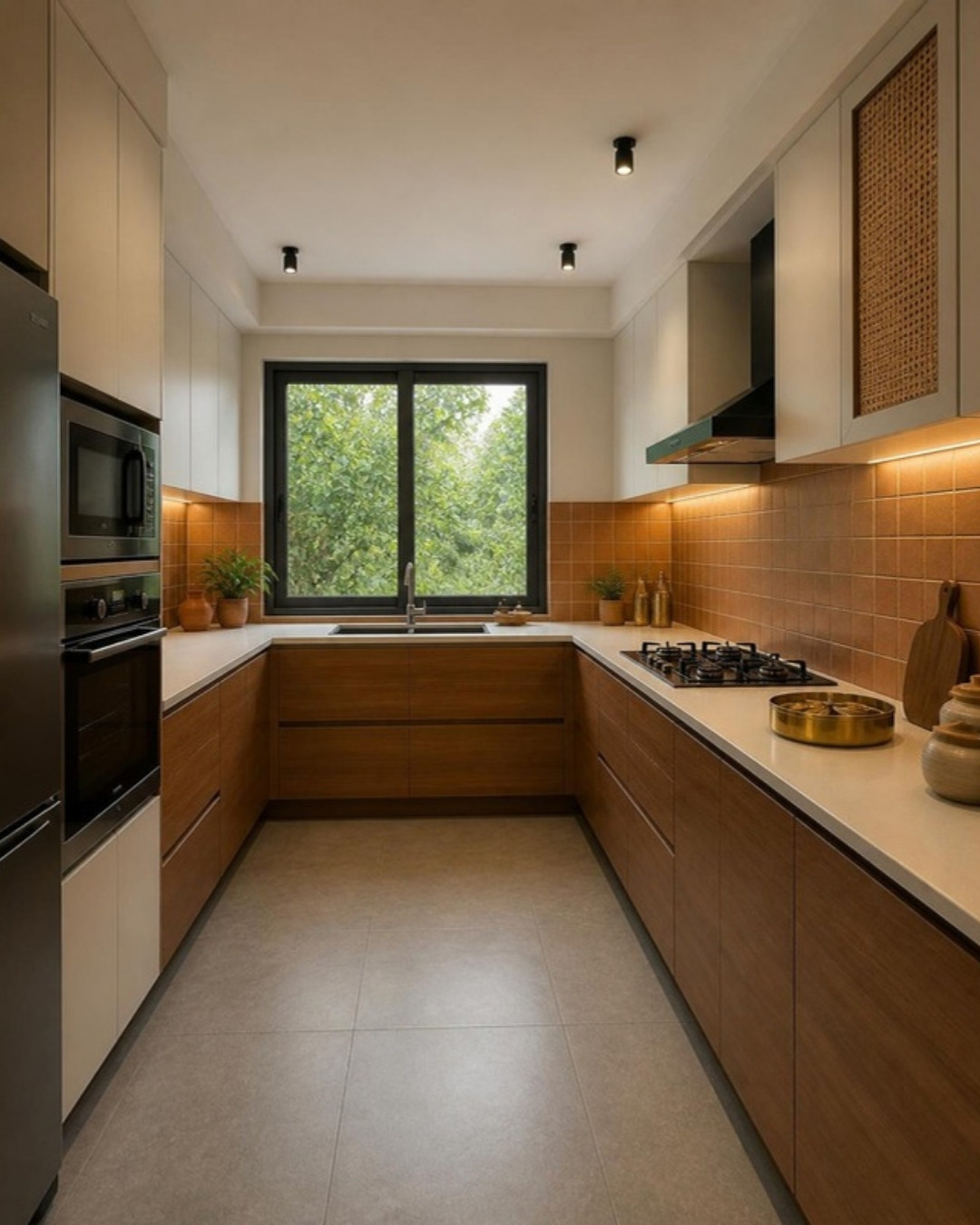
HDHMR and WPC both arrived as answers to the same problem: plywood that swells, delaminates or attracts termites in damp parts of the home. They solve it in different ways, and they fail in different ways. Knowing which is which will save you a rebuilt sink unit.
What each board is
HDHMR stands for High Density High Moisture Resistance. It is hardwood fibre compressed with resin into a dense, uniform board. It resists humidity, but it is still a wood-fibre product.
WPC stands for Wood Plastic Composite. It blends wood powder with a polymer, usually PVC, and additives. The plastic content is what makes it waterproof.
HDHMR vs WPC: side by side
| Factor | HDHMR | WPC |
|---|---|---|
| Water | Moisture resistant; swells with standing water | Waterproof |
| Termites and borers | Resistant | Not a food source for termites |
| Screw holding | Good | Fair; needs the right screws and care |
| Heat | Stable at kitchen temperatures | Can soften or deform near strong heat |
| Surface for laminate or paint | Excellent | Good; needs correct adhesive |
| Strength over wide spans | Better | Can flex; needs support |
| Feel and sound | Solid, wood-like | Slightly hollow, plastic-like |
| Price | Lower | Usually higher for good density |
WPC boards vary a lot in density. A light, cheap WPC sheet behaves very differently from a dense one, so ask for the density and the brand.
Where WPC is the better choice
- Bathroom vanities. Daily splashes and wet floors.
- The sink base unit. The one kitchen cabinet most likely to see a leak.
- Utility and wash areas. See utility planning in our kitchen layout guide.
- Balcony storage that is shaded but exposed to damp air.
- Skirting and plinths that get mopped every day.
Where HDHMR is the better choice
- Shutters across kitchens and wardrobes, for flatness and finish
- Wardrobe and TV unit carcasses in dry rooms
- Routed, fluted and handle-less designs
- Wall panelling
- Units near the hob, where heat rules out WPC
For how HDHMR compares with plywood in the same roles, read HDHMR vs plywood.
What about BWP plywood?
For wet zones, BWP plywood made to IS 710 remains the third option. It holds screws better than WPC and carries a stone countertop well, but it is still wood and must be sealed at the edges. Many kitchens use BWP plywood for the sink unit carcass and WPC only for the base panel and plinth, where water sits. Our BWR and BWP guide explains the grades.
Can a full kitchen be made in WPC?
It can, and it is sold that way, but we do not usually recommend it. WPC near the hob and oven faces heat it is not suited to. Hinges on tall WPC shutters can loosen over time unless the fixing is done with care. Long WPC shelves need extra support. A kitchen built with WPC in the wet zone and plywood or HDHMR elsewhere uses each material where it is strong.
Fitting matters as much as the board
- Use screws meant for the board, with pre-drilled holes
- Seal every cut edge of HDHMR with edge banding
- Use a compatible adhesive for laminate on WPC
- Keep WPC away from direct heat sources
- Fix a leak the day you see it, whatever the board
How it should appear on your quotation
Each unit should name its board: for example, BWP plywood for the sink carcass, WPC for the sink base panel, BWR plywood for other base units, HDHMR for shutters. A single line saying “waterproof board” hides the decision. See what actually drives interior cost.
Frequently asked questions
WPC for places that get wet. HDHMR for shutters, dry-area carcasses and anything near heat.
Yes, the board itself does not absorb water. Hardware and laminate edges still need proper fitting.
No. It is moisture resistant, which is not the same thing.
Not for screw holding or wide shelves. Its advantage is water, not strength.
Good-density WPC usually costs more than HDHMR of the same thickness.
Choose the board unit by unit
ModScale specifies materials zone by zone for modular kitchens and bathrooms. Book a free design consultation or WhatsApp +91 88845 55998.