
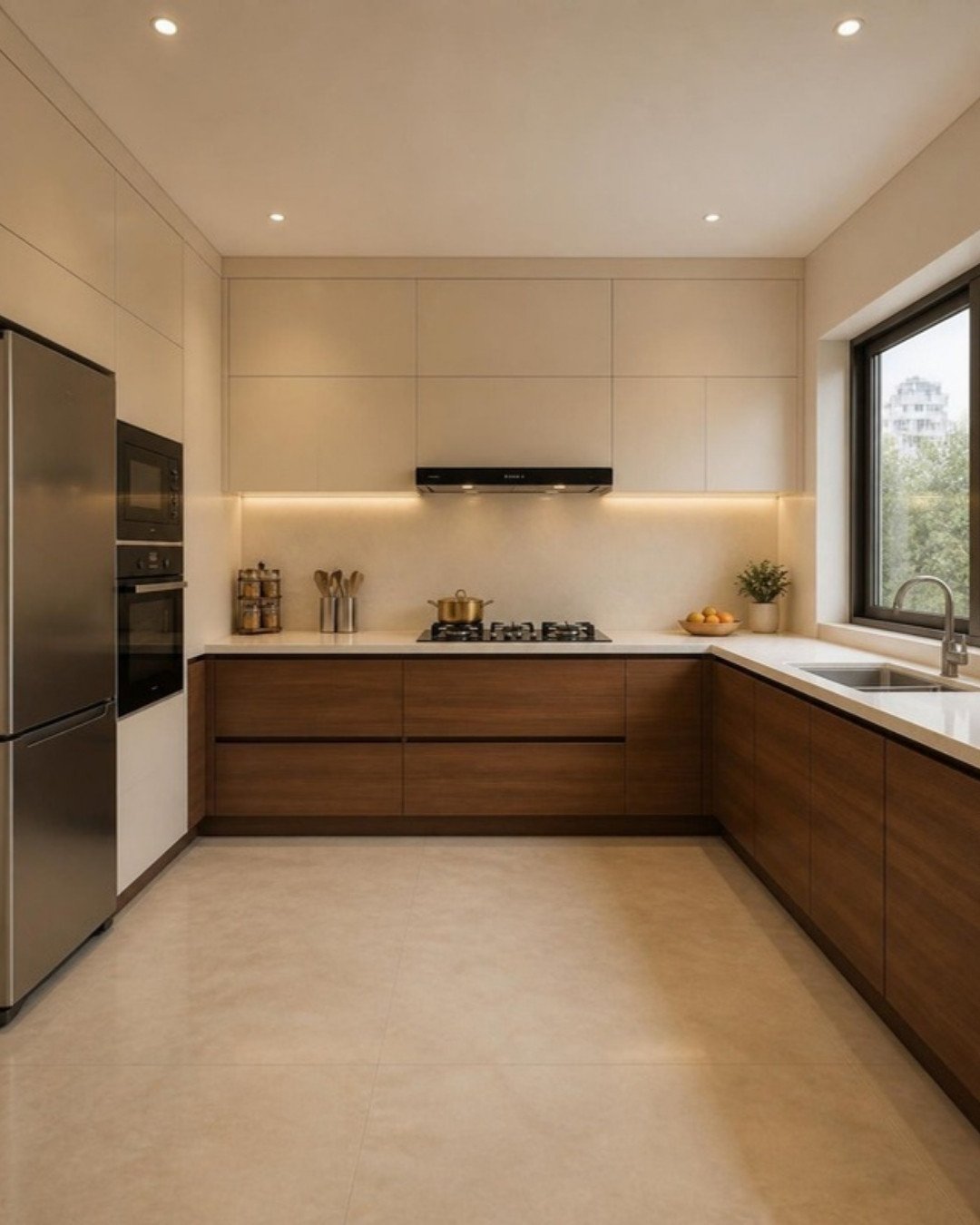
Indian cooking is hard on a kitchen. Tadka, deep frying and long simmering release oil vapour, smoke and strong aromas that settle on shutters, tiles and ceilings as a sticky film. A well-chosen chimney and hob keep the kitchen cleaner and more comfortable; a poorly chosen or poorly installed pair is noisy, weak and a nuisance to maintain.
The most important point in this guide is also the least glamorous: the chimney and hob must be chosen before the kitchen cabinets are designed. Their sizes, the duct route and the countertop cut-out all affect the carpentry. Here is how to choose well.
Chimney first: ducted or ductless?
A ducted chimney pulls air through a filter and pushes it outdoors through a pipe. A ductless (recirculating) chimney passes air through grease and carbon filters and releases it back into the kitchen.
For Indian cooking, ducted is the better choice wherever it is possible. Wonderchef’s chimney buying guide describes ducted models as always more effective and recommends ductless ones only when ducting through a wall is not possible. A recirculating unit traps some grease and odour, but it cannot remove heat or moisture, and its carbon filters need regular replacement.
Before you buy, confirm where the duct will exit. Most apartments have a core-cut hole or provision on an external wall or in the utility area. If there is none, check with your builder or association before cutting one.
Suction capacity: how much do you need?
Suction is quoted in cubic metres per hour (m3/hr). Published guidance differs a little:
- Housing.com’s guide to kitchen chimneys says the ideal suction power for Indian homes should be around 1,000 m3/hr.
- Wonderchef’s buying guide gives a formula of kitchen volume in cubic metres multiplied by 10 as a minimum, suggests multiplying by 12 to 15 for Indian cooking because of heavy frying, and says most Indian modular kitchens need 1,200 to 1,400 m3/hr.
Read these figures with some care. The formula on its own gives quite low numbers for a small apartment kitchen, while the capacities usually recommended are much higher. The gap exists because the rated figure is measured in free-air conditions; once a duct with bends is attached, the air actually moved is lower. A fair conclusion is that a chimney rated somewhere around 1,000 to 1,400 m3/hr suits most apartment kitchens with regular frying and tadka, and that the quality of the ducting matters as much as the number on the box.
Higher suction is not automatically better. Very high-capacity motors tend to be louder, and in an open kitchen noise is a real cost. Compare the noise rating in decibels, where the manufacturer publishes it, at the speed you will normally use.
Filter types
Baffle filters
Baffle filters are stainless-steel panels with overlapping curved channels. Air changes direction as it passes through, and the heavier oil droplets are thrown out and collect in the channels. Because the airflow path stays open even when the filter is greasy, suction holds up well with oily cooking. Wonderchef’s guide describes baffle filters as best for Indian cooking with heavy oil and grease. They need to be removed and washed periodically; they are usually dishwasher-safe.
Mesh (cassette) filters
Layers of fine aluminium mesh trap grease in their pores. They are inexpensive but, as the same guide notes, they clog faster with Indian cooking, and a clogged mesh sharply reduces suction. They need frequent washing and suit light cooking only.
Filterless and auto-clean chimneys
Filterless chimneys have no filter in the air path; the motor’s design throws oil outwards into a collector tray. Auto-clean models add a heating element that melts residue inside the housing so that it drains into the tray, usually at the touch of a button. They reduce the chore of scrubbing filters, which is why they have become popular. They are not maintenance-free: the oil collector has to be emptied and washed regularly, and the unit still benefits from periodic servicing.
Carbon filters
Used in ductless chimneys to absorb odour. They cannot be washed and must be replaced periodically, which is an ongoing cost.
Chimney size and mounting height
The chimney should be at least as wide as the hob. Wonderchef’s guide puts it simply: chimney width should match hob width, so a 60 cm hob takes a 60 cm chimney and a 90 cm hob a 90 cm chimney. Housing.com describes 60 cm chimneys as meant for two-burner stoves and 90 cm chimneys as ideal for three or four-burner stoves. Where the wall allows, a chimney slightly wider than the cooking surface captures fumes better than one that is exactly the same width.
For mounting height, Wonderchef’s guide gives 65 to 75 cm above the hob surface. Too low and the chimney obstructs tall vessels and risks heat damage; too high and fumes escape before they are captured. Always follow the installation manual for your specific model, since manufacturers state their own range, and gas hobs generally need more clearance than induction.
Ducting: where good chimneys go wrong
A strong chimney on a bad duct performs like a weak one. The principles are straightforward:
- Keep it short and straight. Every metre and every bend reduces airflow. Aim for the shortest practical run with as few bends as possible, ideally no more than one or two.
- Use the full diameter. Wonderchef’s guide gives 150 mm as the standard duct diameter. Do not reduce it to fit a smaller hole in the wall.
- Prefer smooth, rigid pipe. Smooth stainless-steel or PVC pipe offers less resistance and collects less grease than a long length of flexible corrugated hose.
- Finish the outlet properly. A cowl or louvre with a back-draught flap outside keeps rain, insects and birds out.
- Conceal with access. The duct can run inside a wall cabinet, a loft or a false ceiling, but leave a way to reach joints for servicing.
Place the hob on or near an external wall where possible. If you are still at the planning stage, our modular kitchen design guide for Indian cooking explains how hob position affects the whole layout.
Choosing the hob
Freestanding cooktop or built-in hob?
A freestanding cooktop sits on the counter on short legs and connects by a hose. It is the lower-cost option, easy to lift for cleaning underneath, simple to service or replace, and needs no cut-out in the stone. Its burners are generally designed around Indian vessels and high flames.
A built-in hob is dropped into a cut-out in the countertop and sits nearly flush. It looks cleaner, usually has auto-ignition and often a flame failure device that cuts the gas if the flame goes out. Its drawbacks are a higher cost, the need for a precise cut-out, service access from the cabinet below, and the fact that spills cannot be wiped away under the unit. A future replacement must match the cut-out size, so keep the dimensions on record.
Neither is wrong. Choose a built-in hob for appearance and safety features if you accept the upkeep; choose a cooktop for simplicity and easy servicing.
Burners, size and material
- Number and spacing. Count how many vessels you really use at once. Three well-spaced burners are often more usable than four cramped ones; a pressure cooker, a kadai and a tawa should sit side by side without touching.
- Burner type. Brass burners are durable and distribute heat evenly, and they are the usual preference for Indian cooking. A high-output or multi-ring burner is useful for large vessels and quick tadka.
- Width. Hobs commonly come in 60, 75 and 90 cm widths. A wider hob takes counter space from the preparation area in a small kitchen.
- Top surface. Toughened glass looks smart and wipes clean but can be damaged by impact or by oversized vessels trapping heat; stainless steel is forgiving but shows scratches.
- Pan supports. Cast-iron supports are heavy and stable for large vessels.
- Gas type. Confirm that the hob is configured for your supply, LPG cylinder or piped natural gas, and have any conversion done by an authorised technician.
What your interior designer needs from you
- The chimney and hob model numbers, or at least the widths, before the kitchen drawings are finalised.
- The duct exit location and route, so wall units can be planned around it.
- The hob cut-out dimensions from the manufacturer’s manual, for the countertop fabricator. See our guide to kitchen countertop materials for how different stones handle cut-outs and heat.
- A switched socket for the chimney at high level, hidden behind the hood or in the adjoining cabinet, and one below the counter if the hob has electric ignition.
- An accessible gas shut-off valve.
If you are weighing whether to open the kitchen to the living room, chimney performance becomes even more important; see apartment interior design in Bangalore for how we approach the overall plan. Those who follow Vastu traditionally prefer the hob in the south-east of the kitchen, with the cook facing east. This is a traditional preference rather than a technical rule, and our article on kitchen Vastu for apartments discusses how to reconcile it with a fixed layout.
Frequently asked questions
It is not compulsory, but in a modular kitchen with wall cabinets, and especially in an open kitchen, it makes a large difference to grease build-up, heat and odour. A simple exhaust fan helps with ventilation but does not capture fumes at the source.
Baffle filters and filterless auto-clean designs both handle oily cooking well. Baffle filters need washing; filterless models need the oil tray emptied. Mesh filters clog quickly with Indian cooking.
For most apartment kitchens, yes. Published guidance from Housing.com and Wonderchef ranges from about 1,000 to 1,400 m3/hr for Indian homes. A short, straight, full-diameter duct is what allows the chimney to deliver its rated performance.
Yes, with a recirculating model and carbon filters, but it will not remove heat or moisture and is less effective on smoke. Use it only where ducting outdoors is genuinely impossible.
Built-in hob or regular gas stove?
A built-in hob gives a flush, modern look and often better safety features; a freestanding cooktop is cheaper, simpler to clean around and easier to service. Decide before the countertop is cut, because the choice is hard to reverse.
Planning your interiors? Book a free design consultation or WhatsApp us on +91 88845 55998.