
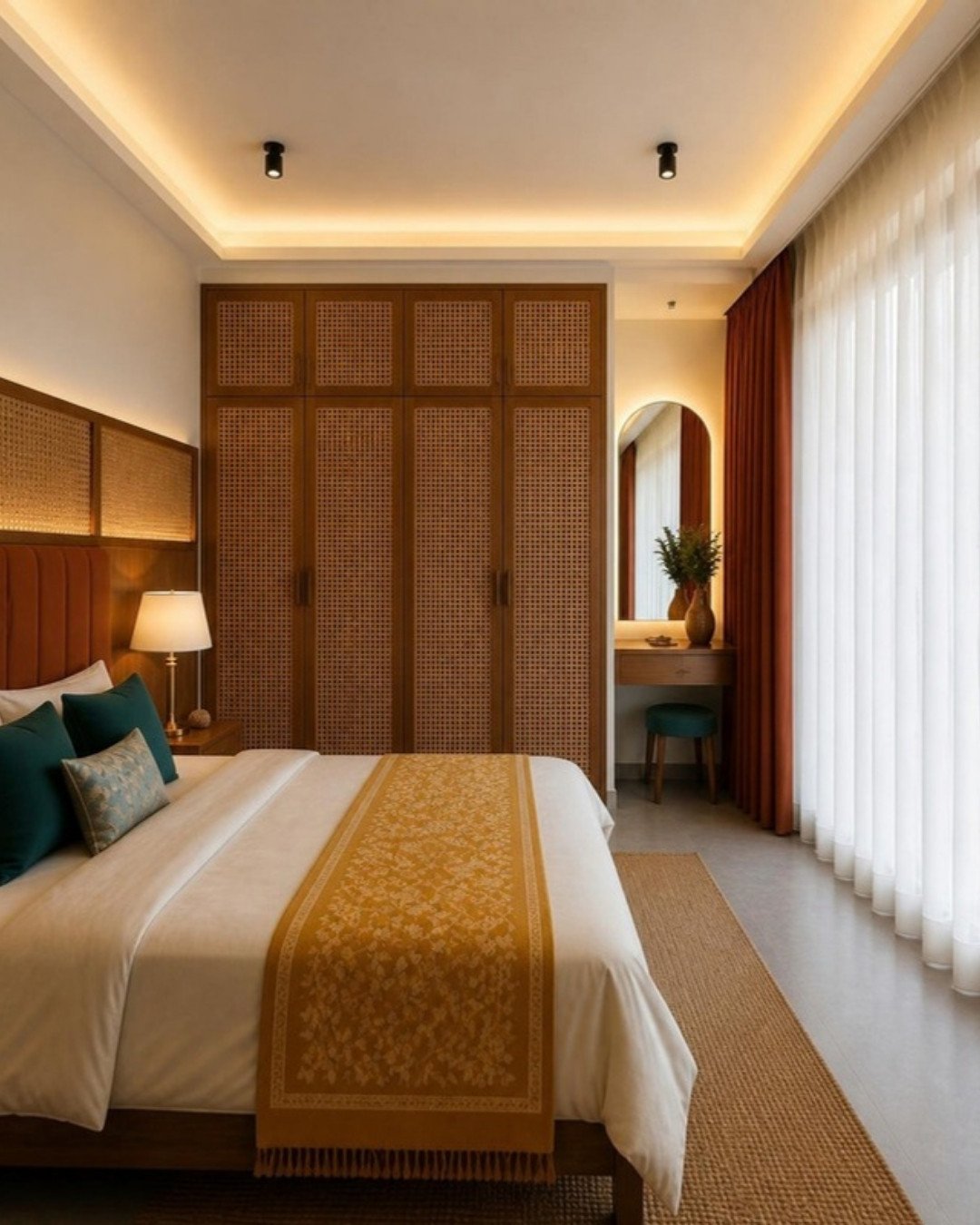
If you are getting quotations for a new flat in Bangalore, the wardrobes often turn out to be one of the biggest single lines – in a 2BHK or 3BHK they can cost as much as the modular kitchen. This guide explains how wardrobe cost in Bangalore is calculated, which choices move the number most, and how to read a quote so you can compare vendors fairly.
All figures below are typical published ranges, not a ModScale price list or a promise. Your actual cost depends on the size, the internal layout, the board, the shutter finish and the hardware you choose.
How wardrobes are priced: per square foot of front area
Most Bangalore vendors price wardrobes on the front (elevation) area of the unit – width multiplied by height – not on the floor area of the bedroom. A few quote per running foot or as a fixed price per unit. None of these methods is wrong, but you cannot compare a per-square-foot quote with a per-unit one without converting them.
A worked example
Take a common master-bedroom wardrobe in a Bangalore apartment:
- Main wardrobe: 7 ft wide × 7 ft high = 49 sq ft
- Loft above it: 7 ft wide × 2 ft high = 14 sq ft
- Total: about 63 sq ft
At a typical laminate rate of ₹1,000–1,500 per sq ft, the woodwork comes to roughly ₹63,000–95,000. The same unit in an acrylic finish at ₹2,000–2,800 per sq ft would be roughly ₹1.26–1.76 lakh. Both figures are before GST, special accessories and lights.
Always ask whether the loft is included in the quoted area or priced separately. It is one of the most common reasons two quotes look different.
Typical wardrobe cost ranges in 2026
Published 2026 cost guides give broadly consistent bands. Housiey’s 2026 interior budgeting guide lists these per-square-foot ranges for India:
| Wardrobe type / finish | Typical range (per sq ft, before GST) |
|---|---|
| Laminate finish | ₹1,000 – 1,500 |
| Acrylic finish | ₹2,000 – 2,800 |
| Sliding wardrobe systems | ₹2,500 – 3,500 |
Design Cafe, which prefers per-unit pricing, groups wardrobes into three tiers in its wardrobe cost explainer (updated March 2026): roughly ₹20,000–50,000 for starter units in MDF or basic plywood, ₹50,000–1.5 lakh for mid-range plywood units with laminate or acrylic, and ₹1.5 lakh and above for premium finishes such as PU or solid wood.
Treat these as a sense-check, not a quote. Bangalore labour, the board brand and the hardware brand can move the figure up or down within – and sometimes beyond – these bands.
What actually changes the price
1. The board inside (carcass)
The cabinet box is where the money should go first, because it decides how long the wardrobe lasts. The usual options are:
- Particle board or MDF – lowest cost, suited to short-term or rental use.
- HDHMR – dense, stable and good for screws; a sound mid-range choice for dry bedrooms.
- BWR or BWP plywood – the most common choice for long-term homes, with better resistance to Bangalore’s monsoon humidity, especially on walls that share a bathroom.
Our materials guide explains the grades in more detail. Whatever you choose, ask every vendor to quote the same board so you are comparing like with like.
2. The shutter finish
Shutters are what you see every day, so this is where most people are tempted to spend. Roughly in order of cost:
- Laminate – durable, wide range of colours and woodgrains, easy to maintain.
- Acrylic – high-gloss or matt, a cleaner modern look, but shows scratches more easily.
- PU paint – seamless finish in any colour; needs skilled application.
- Veneer – real wood surface; needs polishing and care.
- Glass and profile shutters – often used for a section rather than the full wardrobe.
A useful way to control budget is to use a premium finish only on the most visible wardrobe (usually the master bedroom) and laminate in the kids’ and guest rooms.
3. Sliding or hinged shutters
Sliding wardrobes need a good-quality track and soft-close mechanism, and the shutters themselves are larger and heavier, so they usually cost more than hinged ones of the same size. They make sense where there is less than about 2.5 ft of clearance in front of the wardrobe. Hinged shutters give full access to the inside and are easier to repair. We compare the two in detail in sliding vs hinged wardrobes.
4. Hardware and internal accessories
Hinges, channels and handles are small items with a big impact on daily use. Branded soft-close hinges and drawer channels cost more than generic ones but are the parts that fail first when quality is poor. Internal accessories add further cost, often priced separately:
- Pull-out trouser and tie racks
- Jewellery or accessory drawers with dividers
- Pull-down hanger rods for tall wardrobes
- Profile lights or sensor lights inside the wardrobe
- Locker or safe compartments
Choose the accessories you will actually use. A well-planned layout with plain shelves, drawers and hanging space often works better than a wardrobe packed with gadgets.
5. Size, lofts and the internal layout
More drawers and more partitions mean more material and more labour than open hanging space. Full-height wardrobes that go up to the ceiling avoid a dusty gap on top but add loft area to the bill. If a bedroom has a sloping beam or an uneven wall, expect a small increase for scribing and filler panels.
6. Dresser, study or TV unit attached
Many Bangalore bedrooms are small enough that the wardrobe also holds a dressing mirror, a study ledge or a TV panel. These combined units save floor space but are priced as additional modules. Check whether the dresser is counted in the wardrobe area or as a separate line.
Wardrobe budgets for a whole flat
As a planning guide, a typical Bangalore 2BHK has two full-height wardrobes with lofts, and a 3BHK has three, often with a larger unit or a small walk-in in the master bedroom. In our 3BHK interior cost guide, wardrobes and storage typically account for roughly 12 to 18 per cent of the total interior budget.
A simple way to estimate your own figure:
- Measure the wall available for each wardrobe (width) and the ceiling height.
- Multiply width by height for each wardrobe, including lofts.
- Add up the total square feet across all bedrooms.
- Multiply by a rate band that matches your board and finish.
- Add accessories, lights and GST.
This gives you a realistic starting range before you speak to a designer, and helps you spot a quote that is far out of line.
How to compare wardrobe quotations
When two quotes differ, the reason is usually in the specification rather than the headline rate. For each wardrobe, ask for:
- The exact board and its grade (for example, BWP plywood, 18 mm carcass, 6 or 9 mm back panel)
- The shutter finish and brand, inside and outside
- Hinge and channel brand, and whether they are soft-close
- Whether the loft, skirting and filler panels are included in the area
- A drawing showing the internal layout, with every drawer and shelf marked
- What is excluded – handles, lights, mirrors, locks and GST
- The warranty, and what it covers
Our guide on how to compare interior quotations walks through this for the whole home.
Five ways to get more for your wardrobe budget
- Spend on the box and the hardware first. A good carcass with good hinges outlasts a fancy shutter on a weak box.
- Use one premium finish, not five. Pick one statement wardrobe and keep the rest simple.
- Plan the inside around what you own. Count your long dresses, sarees, suits and folded clothes before deciding hanging versus shelf space.
- Keep lofts simple. Lofts are for occasional storage – plain shutters and shelves are enough.
- Finish electrical work first. Wardrobe lights and sensors need wiring before the units are installed.
If you would like to see how we approach layouts and finishes, our wardrobe design page covers the planning in more detail.
Frequently asked questions
What is the typical wardrobe cost per sq ft in Bangalore?
Published 2026 guides put laminate wardrobes at roughly ₹1,000–1,500 per sq ft, acrylic at ₹2,000–2,800 and sliding systems at ₹2,500–3,500, before GST. Your rate depends on board, finish and hardware.
Is wardrobe cost calculated on the room’s carpet area?
No. It is usually calculated on the front area of the wardrobe – width multiplied by height – including lofts if they are part of the unit.
How much does a wardrobe for a master bedroom cost?
A 7 ft wide, full-height wardrobe with a loft is about 63 sq ft. At typical laminate rates that is roughly ₹63,000–95,000; in acrylic, roughly ₹1.26–1.76 lakh, before GST and accessories.
Are sliding wardrobes more expensive than hinged ones?
Usually yes, because of the track system and larger shutters. They are worth it where clearance in front of the wardrobe is limited.
Which board is best for wardrobes in Bangalore?
BWR or BWP plywood is the common long-term choice, particularly for walls next to bathrooms. HDHMR is a sound alternative for dry walls if it is well edge-banded.
Planning your interiors? Book a free design consultation or WhatsApp us on +91 88845 55998.