
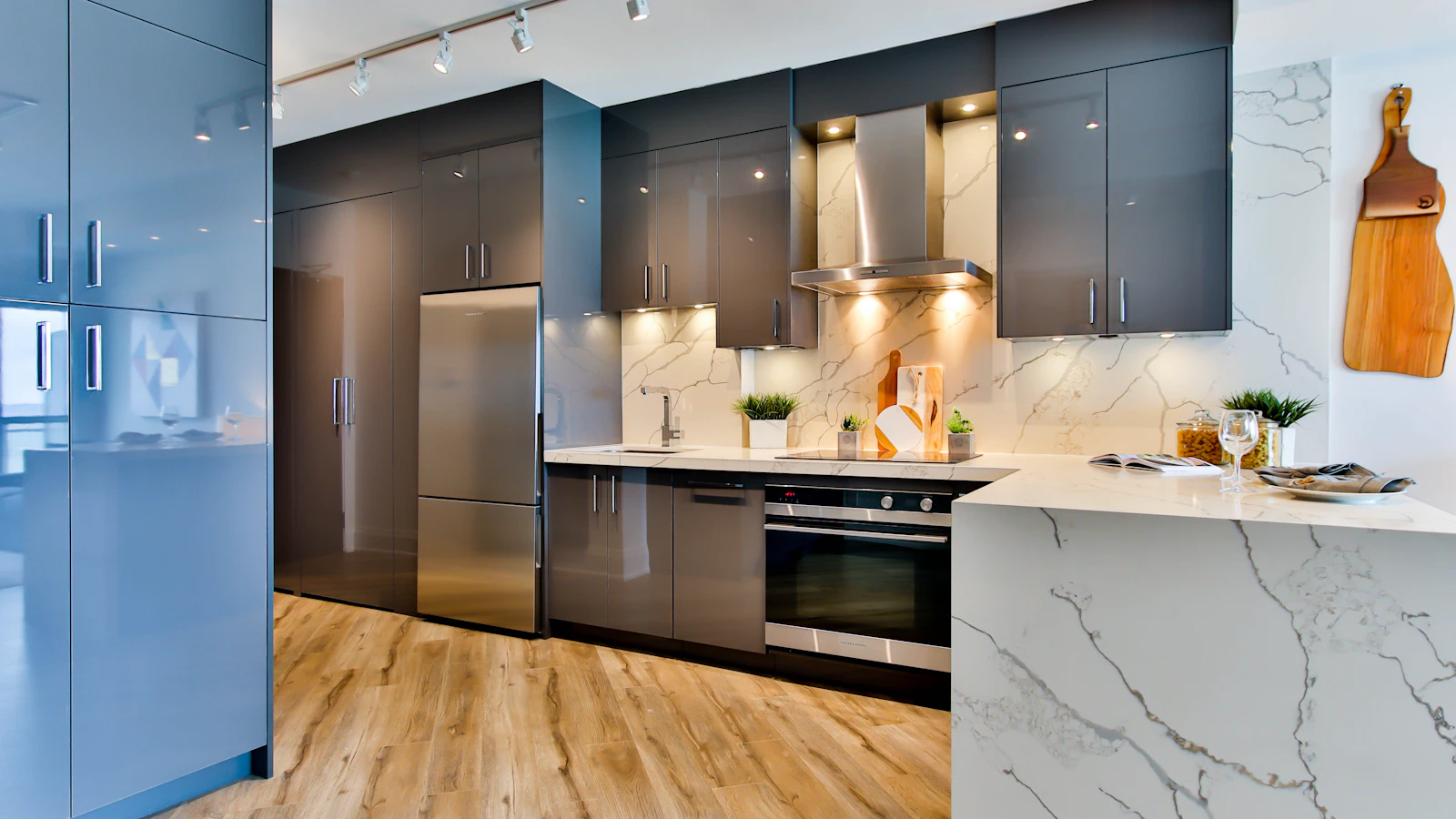
Short answer: an aluminium kitchen is the safer choice where water, damp walls or termites are a real and recurring problem, and where you are happy with a simpler, more uniform look. A BWP plywood kitchen with good edge sealing gives you far more choice of finish, sturdier screw-holding for heavy hardware and easier repairs, and it handles a normal apartment kitchen in Bangalore comfortably. Many homes end up best served by a mix: aluminium under the sink and in the utility, plywood everywhere else.
Aluminium kitchen cabinets have gone from a coastal-town speciality to something homeowners across India now ask about. This guide compares the two carcass materials honestly, so you can decide on the basis of your own kitchen and not a sales pitch.
What each term means
Aluminium modular kitchen
The cabinet frame is built from extruded aluminium profiles. The sides, back and shutters are usually aluminium composite panels, aluminium honeycomb panels or glass set into aluminium frames. There is no wood-based board in the carcass, which is the whole point.
Plywood modular kitchen
The cabinet boxes are cut from plywood and finished with laminate inside. Shutters may be laminate, acrylic, PU or glass. Plywood comes in grades; at ModScale we use only BWP (boiling water proof) plywood for carcasses, because it is bonded with phenolic resin and stands up to kitchen moisture much better than lower grades. Our guide to plywood grades explains the differences.
Side-by-side comparison
| Factor | Aluminium | BWP plywood |
|---|---|---|
| Water | Does not absorb water or swell | Highly water resistant; exposed, unsealed edges are the weak point |
| Termites and borers | Not a food source | Treated, but still wood; needs a dry, protected site |
| Finish choice | Limited: powder-coated colours, wood-look films, glass | Very wide: laminate, acrylic, PU, veneer, glass |
| Feel and sound | Lighter, can sound hollow or rattle if poorly made | Solid, quiet, familiar |
| Dents and scratches | Thin panels can dent; dents are hard to remove | Laminate resists knocks; a damaged shutter is easily replaced |
| Hardware | Depends on the profile system; check tandem drawers and lift-ups are supported | Holds screws well; works with almost all hinges, channels and pull-outs |
| Custom sizes | Possible, but fewer fabricators and less flexibility for odd shapes | Easily made to any size, including fillers and corner units |
| Repairs later | Needs the same profile system and fabricator | Any competent carpenter or factory can match and replace parts |
Where aluminium wins
- The sink unit. This is where most kitchen damage begins: a slow leak from a trap or inlet pipe that nobody notices for weeks. An aluminium sink cabinet is unaffected.
- Ground-floor homes and older buildings with rising damp, seepage through an external wall or a history of termites.
- Utility and wash areas that are open to rain or washed down with water.
- Rental flats where you cannot supervise how the kitchen is used or how quickly a leak is reported.
Where plywood wins
- Design. If you want a particular colour, a matt PU finish, veneer warmth or handleless profiles, plywood carcasses with the shutter of your choice give far more freedom. See our comparison of PU, acrylic and laminate.
- Heavy storage. Tall pantry pull-outs, loaded grain drawers and stone counters all sit on the carcass. Thick plywood sides hold fixings firmly over years of daily use.
- Odd layouts. Beams, shafts, offsets and corners are routine in Bangalore apartments, and plywood is easily scribed around them.
- Long-term serviceability. Ten years on, a shutter can be refaced or a drawer rebuilt without hunting for a discontinued profile.
What decides whether a plywood kitchen lasts
Most plywood kitchens that fail do so because of workmanship, not the material. Check for these before you sign:
- BWP-grade plywood for all carcasses, stated in writing with the brand.
- Edge banding on every exposed edge, including the back and bottom of the sink unit.
- Carcasses raised on PVC or stainless-steel legs with a removable skirting, not resting on the floor.
- An aluminium or waterproof liner on the floor of the sink cabinet.
- A sealed joint between counter, sink and backsplash.
Our article on termite and moisture protection for woodwork goes further into site preparation.
Cost: what actually moves the number
We are not quoting a rate here, because a figure without a drawing misleads. As a general pattern in the market, a full aluminium kitchen tends to be priced above a laminate-finished plywood kitchen of the same size, and closer to or below plywood kitchens with premium acrylic or PU shutters. The gap depends on:
- the thickness and grade of the aluminium profile and panel;
- how many glass or profile shutters are used;
- the hardware brand and the number of drawers and pull-outs;
- whether it is a standard-module kitchen or fully made to measure.
Ask for an itemised quotation for both options on the same layout and the same hardware so the comparison is fair. For how kitchens are usually priced, see modular kitchen price per square foot in Bangalore.
The hybrid approach
You do not have to choose one material for the whole kitchen. A practical specification for a Bangalore apartment is:
- aluminium or aluminium-lined sink unit;
- BWP plywood carcasses for all other base, wall and tall units;
- aluminium-framed glass shutters on a few wall units for lightness;
- aluminium cabinets in the utility balcony.
This puts metal where the water is and wood where the weight and the looks are.
Frequently asked questions
Is an aluminium kitchen better than a plywood kitchen?
It is better against water and termites and weaker on finish choice, dent resistance and ease of repair. For a dry, well-ventilated apartment kitchen, BWP plywood is usually the more versatile choice; for damp or termite-prone sites, aluminium is safer.
Do aluminium kitchen cabinets rust?
Aluminium does not rust the way steel does. It forms a thin oxide layer, and powder coating adds protection. In very humid or coastal air, cheap coatings can discolour or pit over time, so ask about the coating and the hinge and screw material.
Can an aluminium carcass carry a granite or quartz counter?
A properly engineered frame can, but confirm the profile thickness and support spacing with the fabricator, particularly over wide drawers and at the sink and hob cut-outs.
Which plywood does ModScale use for kitchens?
BWP-grade plywood for carcasses, with the shutter finish chosen to suit the design and budget.
Planning your kitchen? See how we design and install modular kitchens in Bangalore, book a free design consultation or WhatsApp us on +91 88845 55998.
Representative image: Photo by Lotus Design N Print on Unsplash. It does not show a ModScale project.